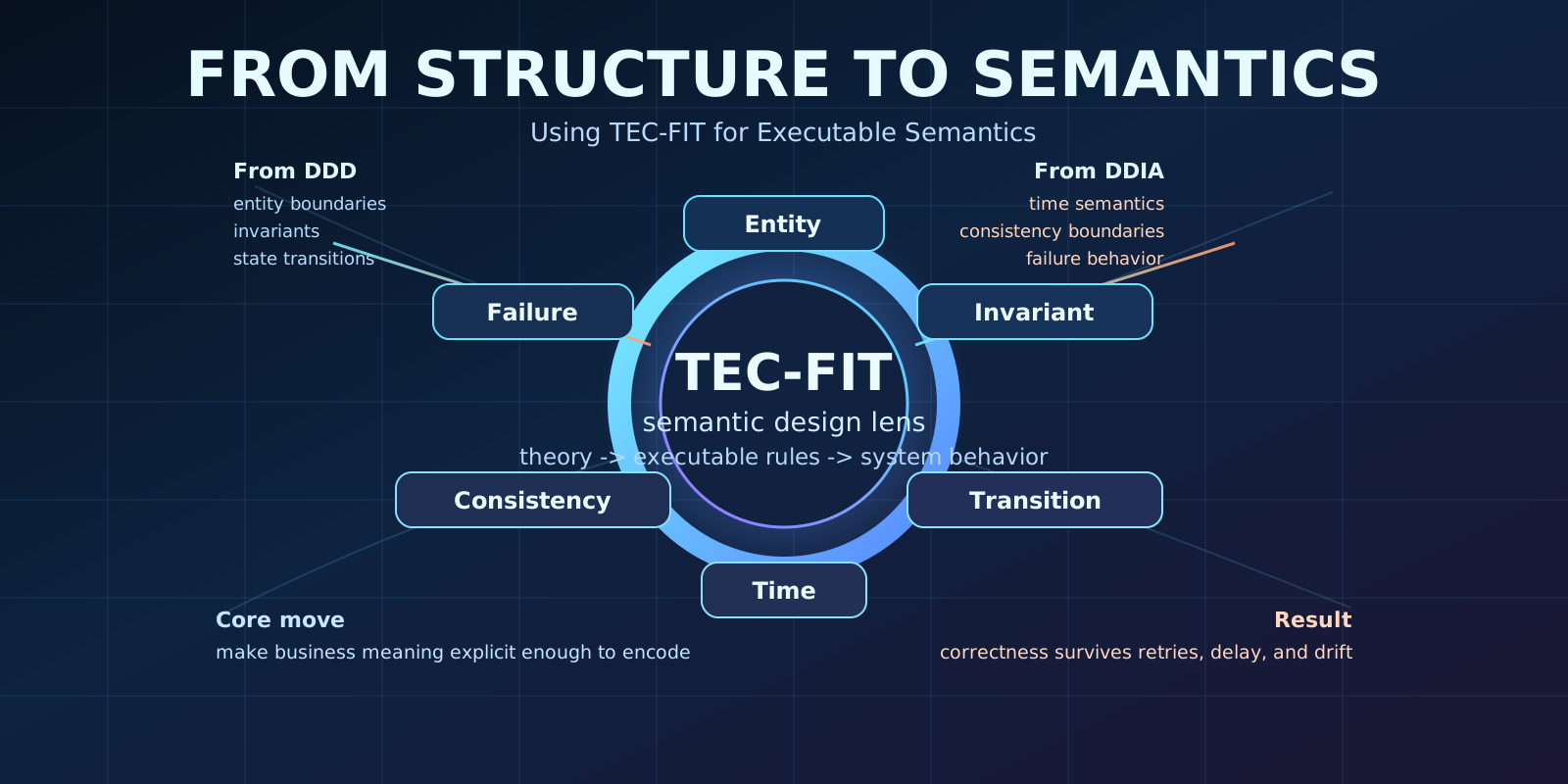
From Structure to Semantics: Using TEC-FIT for Executable Semantics
“…and brought them unto Adam to see what he would call them… and whatsoever Adam called every living creature, that was the name thereof.”
Genesis 2:19 (KJV)

A lot of engineers begin taking system design seriously as they grow into senior roles.
At first, that usually means learning structure: layers, boundaries, decomposition, service responsibilities, data flow, and architecture patterns. Those things matter. They are part of how we learn to handle larger systems.
But after a while, structure stops being the whole story.
A system can be cleanly layered, well-factored, and still semantically wrong. A status can mean different things in different parts of the product. A derived view can drift from the underlying facts. A retry path can quietly violate a business rule that the architecture diagram never made visible.
That is the shift this essay is about.
Moving from structure to semantics means realizing that senior design is not only about how a system is organized. It is also about what the system is allowed to mean.
That is what eventually led me to a simple lens I now use a lot:
EntityInvariantTransitionTimeConsistencyFailure
I call it TEC-FIT.
This article is not really about presenting a brand new framework. It is about explaining where that lens came from. For me, it emerged from the overlap between two books that shaped how I think about design:
- Domain-Driven Design
- Designing Data-Intensive Applications
When I say Domain-Driven Design here, I mean primarily Eric Evans’ original book. Later DDD writing made some of the implementation-side lessons easier to apply, but the source of the core framing for me is still Evans.
| Domain-Driven Design | Designing Data-Intensive Applications |
|---|---|
 |  |
Why These Two Books Matter Together
The books solve different problems.
- Domain-Driven Design helps answer: what does the business mean?
- Designing Data-Intensive Applications helps answer: what happens to that meaning when data moves through a real system?
That distinction matters.
DDD pushes you to sharpen concepts such as identity, lifecycle, rules, and boundaries. DDIA pushes you to think about retries, reordering, replication, caching, projections, and time.
One gives you semantic precision.
The other gives you operational realism.
Put together, they force a more demanding design question:
How do we preserve meaning under real system behavior?
What I Take from DDD
The most important lessons I take from Domain-Driven Design are:
- business language should be precise enough to model
- important concepts deserve explicit boundaries
- invariants should live close to the model that owns them
- not every noun needs to become a first-class concept, but the expensive ones do
Primarily from Eric Evans, DDD changed how I look at domain objects.
I stopped seeing them as containers for fields and started seeing them as carriers of meaning. Identity, lifecycle, and rule ownership became design questions, not just naming questions.
That shift is where Entity, Invariant, and much of Transition come from in TEC-FIT.
What I Take from DDIA
The biggest lesson I take from Designing Data-Intensive Applications is that meaning is fragile once data starts moving.
The book keeps pulling attention back to things teams often postpone:
- retries
- duplicates
- projections
- caches
- ordering
- replication
- event time versus processing time
- strong versus eventual consistency
DDIA is valuable because it refuses to let a design stay idealized.
A model may look coherent on a whiteboard and still break in production because timestamps were underspecified, projections drifted, retries were not idempotent, or stale data overwrote fresher state.
That is where Time, Consistency, and Failure in TEC-FIT come from, and it is also where Transition becomes more than a state machine on paper.
How TEC-FIT Emerged
I did not derive TEC-FIT from one single chapter or diagram. It emerged because the same design questions kept recurring across both books.
The mapping now looks fairly natural:
-
EntityDDD asks what the core thing is, what gives it identity, and which data is part of its meaning. -
InvariantDDD asks what must never be violated and which part of the model owns that responsibility. -
TransitionDDD makes lifecycle explicit; DDIA reminds you that transitions are stressed by async behavior, retries, and delayed updates. -
TimeDDIA makes it impossible to stay vague about timestamps, ordering, windows, and late-arriving events. -
ConsistencyDDIA forces you to decide what must agree, when, and across which projections or storage boundaries. -
FailureDDIA treats failure as normal system behavior, while DDD makes you ask what those failures mean for the domain.
That is why TEC-FIT feels practical to me. It captures the semantic pressure points that repeatedly show up when business meaning meets real systems.

Why This Lens Helps
TEC-FIT is useful because it turns abstract design quality into concrete questions.
Instead of saying:
- use clean architecture
- split this into services
- add a repository
it pushes the conversation toward:
- What is the entity?
- What must never be wrong?
- How is state allowed to change?
- Which notion of time matters here?
- What must stay consistent?
- How does the model behave under retries, duplication, and failure?
That is a better starting point because structure can serve those answers instead of substituting for them.
From Theory to Executable Semantics
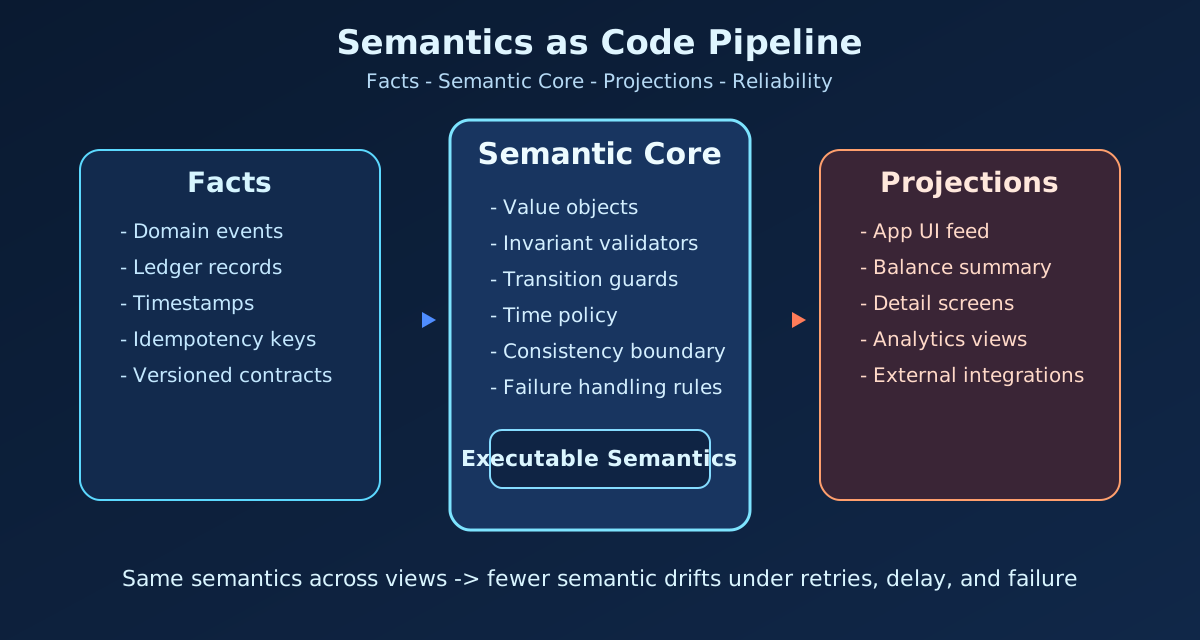
Once the semantic questions are explicit, the next step is to encode them.
That usually means:
- value objects for important concepts
- validators for invariants
- transition guards for lifecycle rules
- well-defined projections
- idempotent handlers
- tests that protect interpretation, not just implementation
In other words, the goal is not just semantics.
The goal is executable semantics.
What the Two Books Ultimately Contribute
If I had to compress the relationship into one sentence, it would be this:
- Eric Evans’ DDD tells me what the domain needs to mean.
- DDIA tells me what can go wrong when that meaning is implemented in a real system.
TEC-FIT is my shorthand for holding both at the same time.
It is not a replacement for those books. It is a distilled design habit I took from reading them closely and applying them repeatedly.
Final Thought
I still care about structure. Everyone should.
But structure is not where correctness begins.
Correctness begins when the system is clear about meaning:
- what it is modeling
- what must never be wrong
- how change is allowed
- how time, consistency, and failure affect interpretation
That is why TEC-FIT exists for me.
It is the point where lessons from DDD and DDIA become a practical checklist for semantic design.