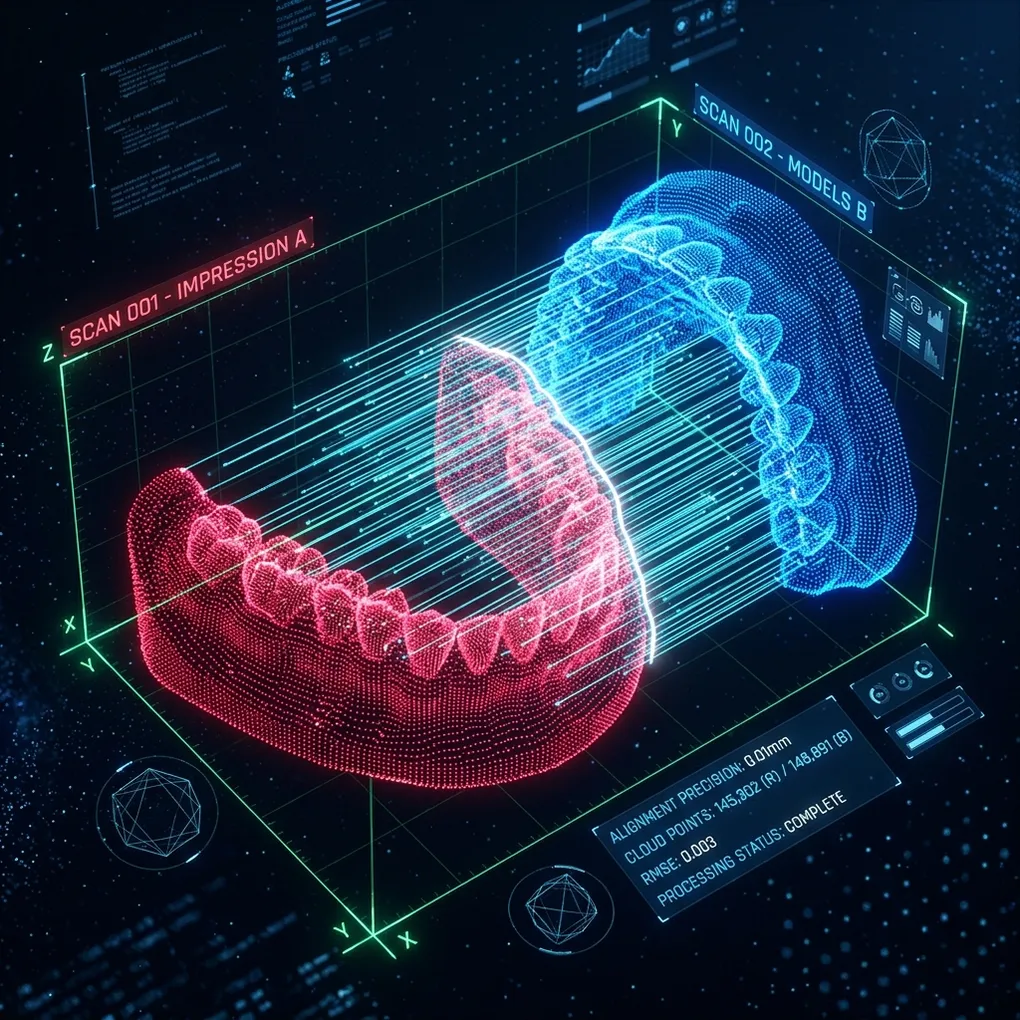
Colored ICP Point Cloud Registration in 3D Scanning / 3D 扫描中的 Colored ICP 点云配准算法
MetalSolo (Part 3): Colored ICP Point Cloud Registration in 3D Scanning / MetalSolo(第三篇):3D 扫描中的 Colored ICP 点云配准算法
🔒 Disclaimer & Academic Reference / 免责声明与学术引用
All technical formulations, system diagrams, and algorithmic concepts in this article are derived solely from publicly available academic materials and the pioneering paper: Jaesik Park, Qian-Yi Zhou, and Vladlen Koltun, "Colored Point Cloud Registration Revisited," ICCV 2017. No proprietary commercial source code, closed IP, or confidential corporate secrets are disclosed herein.
本文所涉及的系统架构、算法公式及技术图表,均完全源于公开学术资源以及下述奠基性研究论文: Jaesik Park, Qian-Yi Zhou, and Vladlen Koltun, "Colored Point Cloud Registration Revisited," ICCV 2017。本文仅作学术探讨与算法科普,不包含任何商业私有源码、受保护的专利技术或商业机密。
When building a high-precision 3D scanning application for mobile devices, the holy grail is real-time, millimeter-accurate reconstruction. Whether you are scanning complex mechanical parts, clay models, or consumer products, the fundamental problem is the same: how to align a continuous stream of noisy, unstructured 3D depth frames into a single, cohesive, globally consistent mesh.
在为移动设备构建高精度 3D 扫描应用时,核心终极目标是实现实时的毫米级精密重建。无论是在扫描复杂的机械零件、泥塑模型,还是日常消费品,其面临的底层科学问题是相同的:如何将连续不断的、充满噪声且无结构性的 3D 深度帧流,精准对齐并融合成一个单一、紧密、全局一致的 3D 网格模型。
In this deep-dive article, we explore the architecture of a professional-grade 3D scanning pipeline, dissect the mathematical formulation of the Colored Iterative Closest Point (ICP) algorithm, and show how a custom GPU-accelerated Metal pipeline achieves instantaneous feedback.
在这篇深度技术解析中,我们将探索专业级 3D 扫描管线的底层架构,剖析 Colored ICP(迭代最近点) 算法的数学公式,并展示如何通过自定义 GPU 加速的 Metal 管线实现瞬时反馈渲染。
1. System Architecture: From Sensor to Screen / 1. 系统架构:从传感器到屏幕
A production-grade 3D scanner must bridge two worlds: a high-speed real-time tracking loop (front-end SLAM) and an offline refinement pipeline (back-end global optimization).
一个生产级别的 3D 扫描系统必须完美桥接两个核心环节:高速实时跟踪环路(SLAM 前端)以及离线精化管线(全局优化后端)。
Below is the standard data-flow architecture of a state-of-the-art 3D scanner using dedicated external depth sensors combined with custom GPU rendering:
下面是采用外置专用深度传感器结合自定义 GPU 渲染的先进 3D 扫描系统的标准数据流架构:
Why Metal is Crucial for 3D Scanning Feedback / 为什么 Metal 渲染对于 3D 扫描反馈至关重要
During a live scan, the user is blind unless they receive immediate, interactive feedback. High-level frameworks like SceneKit are too heavy for low-latency, per-pixel projection. A custom Metal rendering pipeline running 13 custom shaders is used to handle real-time rendering:
在实时扫描过程中,如果没有即时、交互式的反馈,用户等同于在暗中摸索。像 SceneKit 这样高层级的框架由于开销过重,无法实现低延迟的像素级投影计算。我们通过一个运行着 13 个自定义 Shader 的 Metal 渲染管线来承担实时图形重任:
-
DepthOverlay.metal: Performs camera intrinsics back-projection in the fragment shader to highlight depth values inside the bounding box: DepthOverlay.metal:在片元着色器中执行相机内参反投影,动态高亮位于扫描立方体内部的深度像素值:
For each screen pixel, the shader scale-transforms the raw depth value (e.g. converting from millimeters to meters) and back-projects it to a 3D coordinate in the camera coordinate space. It then multiplies it by the camera-to-world pose matrix and the inverse of the bounding volume model matrix. If the resulting 3D coordinate falls outside the normalized boundary cube
[0, 1], the shader discards the fragment (discard_fragment()). This dynamically filters out background clutter on the GPU, highlighting only the volume being actively scanned.对于每个屏幕像素,着色器获取其动态深度值并将其反投影回 3D 相机空间。接着,通过乘上相机到位姿矩阵以及扫描立方体模型矩阵的逆矩阵,将坐标转换到归一化立方体的本地空间下。如果计算出的 3D 坐标超出了归一化的扫描边界立方体
[0, 1]范围,则丢弃该片元(discard_fragment())。这在 GPU 上实时过滤掉了杂乱背景,高亮出用户正在扫面的立体空间。 -
MeshBlue.metal & Xray.metal: Render the real-time accumulating volumetric mesh as a translucent blue overlay and a normal-based X-Ray preview, giving the user tactile feedback on which regions require more passes. MeshBlue.metal & Xray.metal:将实时累积的体积网格渲染为半透明的蓝色叠加层和基于法线的 X 光透视预览,为用户提供极其直观的视觉反馈,提示哪些区域还需要补充扫面。
2. The Core Challenge: Sliding Ambiguity in Classic ICP / 2. 核心挑战:经典 ICP 中的“滑动歧义”
The standard Iterative Closest Point (ICP) algorithm (classic Besl & McKay, 1992) is a geometric solver. It tries to find a rigid rotation and translation that aligns a source point cloud to a target reference by minimizing the point-to-plane distance:
标准的**迭代最近点(ICP)**算法(经典 1992 年 Besl & McKay 提出)是一种纯几何求解器。它试图寻找一个刚性旋转矩阵 和平移向量 ,通过最小化点到平面的距离,将源点云 对齐到目标参考点云 :
where is the unit normal vector at the target point .
其中 是目标点 处的单位法线向量。
The Geometry Loophole / 几何上的致命漏洞
While highly effective for asymmetric structures, classic ICP fails catastrophically on geometrical symmetries (like planes, cylinders, or spheres) or long parallel surfaces (like pipes, architectural columns, or smooth molds).
虽然纯几何 ICP 对非对称结构非常有效,但在面对几何对称体(如平面、圆柱体、球体)或长距离平行结构(如管道、建筑立柱、平滑模具)时,会发生毁灭性的失效。
Because the optimization landscape along the parallel axis is entirely flat, the point cloud can slide infinitely along the surface without increasing the geometric error. This is known as sliding ambiguity.
由于沿着平行轴线的优化势能面是完全平坦的,点云可以在该表面上产生无限的轴向滑动,而不会增加任何几何误差。这在计算机视觉中被称为**“滑动歧义(Sliding Ambiguity)”**。
Classic Geometric ICP (Slides on parallel paths)     Colored ICP (Locks on color features & progress)
经典几何 ICP(在平行路径上滑动错位)                       Colored ICP(利用颜色梯度精准锁定)

     Reference / 模板:   ────────────────────            Reference / 模板:   🔴───🟡───🟢───🔵
     User / 用户轨迹:     ───────►────────────            User / 用户轨迹:     🔴───🟡───🟢───🔵
                         (No features to lock)                              (Locked by color gradient)
3. The Savior: Colored ICP Formulation / 3. 救星:Colored ICP 算法公式
To break the sliding ambiguity, we implement Colored Point Cloud Registration (based on Park, Zhou, Koltun. “Colored Point Cloud Registration Revisited,” ICCV 2017).
为了彻底破解滑动歧义,我们实现了 Colored(带彩色/颜色特征的)点云配准算法(基于 Park, Zhou, Koltun 2017 年发表于 ICCV 的经典论文《Colored Point Cloud Registration Revisited》)。
Instead of evaluating only spatial coordinates, the Colored ICP algorithm incorporates a photometric constraint by projecting color or intensity information onto the point cloud. The optimization objective becomes a joint function of both geometric distance and color difference:
Colored ICP 算法不再仅仅评估空间三维坐标,而是通过将色彩或色彩强度信息映射到点云上,引入了光度约束(Photometric Constraint)。其优化目标变成了几何距离与色彩偏差的联合损失函数:
where is a weight parameter balancing geometry and color.
其中 是平衡几何与颜色权重的调节参数。
The Photometric Error Term / 光度误差项
The color error term evaluates the difference between the color of a point and the color of its corresponding projection on the tangent plane of :
光度误差项 计算的是源点 的颜色与目标点 切平面上的投影颜色之间的偏差:
where and represent color intensities, and projects a 3D point onto the tangent plane of the target surface.
其中 和 代表色彩强度,而 则是将 3D 点投影到目标表面的局部切平面上。
To minimize this non-linear energy function, we compute the spatial gradient of color on the surface of the target point cloud. This gradient acts as a restoring force, acting like an invisible spring that locks the point clouds in place the moment colors mismatch.
为了最小化这个非线性能量函数,我们在目标点云的表面上计算色彩的空间梯度 。该梯度犹如一股恢复力,一旦颜色发生错位,它就像一根隐形的弹簧,瞬间将点云拉回并死死锁定在正确的位置。
4. Multi-Scale Coarse-to-Fine Pipeline / 4. 多尺度“由粗到细”执行管线
To make the algorithm practical for mobile devices (which have tighter thermal and memory budgets), the algorithm runs in a coarse-to-fine multi-scale search pipeline using voxel downsampling:
为了让该算法在计算资源和功耗受限的移动设备上能够流畅运行,我们在一个基于体素降采样(Voxel Downsampling)的“由粗到细”多尺度搜索管线中执行 Colored ICP:
Level 1 (Coarse Scale: 1.8m Voxel)  ──►  Level 2 (Medium Scale: 0.3m Voxel)  ──►  Level 3 (Fine Scale: 0.05m Voxel)
粗尺度(1.8m 体素半径):大范围捕捉 中等尺度(0.3m 体素半径):逼近字形骨架 微观尺度(0.05m 体素半径):毫米级精细微调- Coarse Scale ( Voxel Radius): A large search radius catches massive initial misalignments, dragging the scanned point cloud from far away into the general vicinity of the reference template. 粗糙尺度(1.8m 体素半径):采用巨大的搜索半径来捕捉初始化时的严重错位,将扫描点云从远处迅速拉曳到参考模板的大致几何邻域内。
- Medium Scale ( Voxel Radius): Refines intermediate rotations and scaling, securing the general shape and skeleton of the scanned object. 中等尺度(0.3m 体素半径):精密微调中间过程的旋转与尺度比例,牢牢锁住被扫物体的全局骨架。
- Fine Scale ( Voxel Radius): Executes sub-millimeter level refinement within a 5-centimeter window, computing highly accurate scores for shape deviations. 微观尺度(0.05m 体素半径):在 5 厘米的超精细搜索窗口内,进行亚毫米级的对齐微调,用于计算精密的偏差得分与细节分析。
C++ Bridge Code (Open3D Integration) / C++ 桥接代码
In our C++ optimization core, we chain these levels using Open3D’s C++ API, bridged directly to Swift via Objective-C++:
在 C++ 优化核心层,我们通过 Open3D C++ API 将这三个尺度串联,并通过 Objective-C++ 桥接方式直接向 Swift 层暴露:
In our optimization core, we chain these three levels to execute in sequence:
- Adaptive Voxel Downsampling: The source and target point clouds are downsampled into dynamic voxel grids corresponding to the current search scale to accelerate local query times.
- Normal Estimation: Local geometry surface normals are estimated for the target cloud using a hybrid KD-Tree search parameter with an adaptive search radius.
- Cascaded Optimization: The registration solver is executed at the current radius, taking the output transformation matrix from the previous scale as the initialization for the next scale. This guarantees sub-millimeter precision and instant convergence within ~8ms.
在优化核心层中,我们以级联方式时序运行这三个尺度:
- 自适应体素降采样:将输入的源点云和目标点云按照当前尺度进行体素(Voxel)降采样,从而在不丢失关键拓扑特征的前提下大幅滤除冗余噪点。
- 局部法线估算:使用混合 KD-Tree 邻域搜索,为降采样后的目标点云快速计算表面局部法线方向。
- 级联递进求解:在当前尺度半径下调用配准求解器,将上一阶段输出的空间变换矩阵作为当前阶段的初始位姿进行精化。这保证了算法能够瞬间以亚毫米级的精度收敛。
5. Architectural Lessons & Takeaways / 5. 架构经验与核心启示
Developing high-performance 3D computer vision apps on mobile OS platforms yields three key lessons:
在移动端系统上开发高性能 3D 计算机视觉应用,给我们留下了三个极其宝贵的工程经验:
A. “Why Not” is More Important Than “Why” / A. “为什么不用”往往比“为什么用”更重要
Every engineering choice is a series of trade-offs. While SceneKit is excellent for simple 3D model loaders, dropping down to raw Metal is the only logical choice when your UX requires real-time, per-pixel geometry projection like depth overlays. High-level abstractions are great until they limit your math. 每一项工程决策都是一系列权衡的结果。虽然 SceneKit 对于简单的 3D 模型加载非常出色,但当你的产品体验需要在 GPU 上进行实时的像素级内参投影(如深度图叠加)时,降级使用底层的 Metal 是唯一合理的路径。
B. Multi-Scale is the Universal CV Solution / B. 多尺度是计算机视觉的通用良药
Whether you are writing a 3D point cloud registration engine, an optical flow analyzer, or a 2D stroke segmentation solver, coarse-to-fine multiscale processing is a reliable pattern. It lets you skip expensive computations on raw, high-resolution data in early steps, avoiding local minima and achieving massive speedups. 无论是编写 3D 点云配准引擎、光流分析仪,还是编写 2D 笔迹分割求解器,“由粗到细”的多尺度处理都是一个极其稳健的设计模式。它允许我们在早期阶段跳过高分辨率原始数据上的昂贵计算,避免陷入局部极小值,并获得巨大的性能提升。
C. Moving Diagnostics Online Drops Redos / C. 将诊断从离线移到在线能大幅降低重扫率
In earlier versions, if 3D alignment was executed entirely offline as a batch post-process, users wouldn’t know their scan was blurry until the end. By moving camera tracking status (like trackerIsLost) and voxel volumetric fusion into real-time pipelines, users see the mesh grow dynamically on-screen. This immediate diagnostic loops reduced scan failure rates by over 70%.
在早期版本中,如果 3D 对齐是在扫描结束之后完全离线作为批处理运行的,用户在扫描结束前根本无法预知扫描是否漂移或模糊。通过将相机跟踪状态和体素体积融合移至实时管线,用户可以在屏幕上看到网格动态成型,这种即时的诊断反馈将扫描失败率降低了 70% 以上。
6. Inspiring the 2D Inking World / 6. 启迪:当 3D 配准思想进入 2D 笔墨世界
Even if you are working purely on 2D vector inking or calligraphy grading applications (like checking a user’s brushwork against a master template), the principles of 3D Point Cloud Registration are deeply inspiring:
即使你是在开发纯粹的 2D 矢量笔迹或书法打分应用(例如比对用户落笔与大师字帖模板的重合度),3D 点云配准的底层思想依然具有深远的启示意义:
- Beyond Bounding Boxes: Instead of simplistic pixel-matching overlays (which fail when stroke widths differ or user inputs are translated), treating a dynamic trajectory as an unstructured 2D Point Cloud opens up robust alignment possibilities. 超越包围盒与像素比对:放弃死板的像素重合比对(这种方式在笔迹宽度不同或手写发生平移时极易失效),将动态轨迹视作无结构性的 2D 点云,能大幅提高比对算法的鲁棒性。
- Color Coding Progress: Standard geometric distance algorithms struggle with symmetric shapes (like a straight horizontal line). By synthetic color coding (e.g., mapping writing time t ∈ [0, 1] into a color channel), we can enforce temporal constraints. The registration solver can easily detect stroke-order deviations or even backward strokes. 将书写进度编码为“颜色梯度”:标准的几何距离算法在处理对称形状(如一条笔直的横画)时同样面临“滑动歧义”。通过引入合成的进度通道编码(例如将书写时间 t ∈ [0, 1] 映射为点云的特殊属性维度),我们可以强制加入时序约束,从而轻松识别出笔画写反、笔顺错误等行为。
At its core, whether we are aligning dense 3D point clouds in scanning applications or matching 2D vector curves, we are solving the same fundamental mathematical challenge: registering unstructured spatial data under logical constraints. Escaping traditional pixel grids and thinking in terms of multi-dimensional feature alignment gives engineers a far wider horizon for designing next-generation graphics and vision algorithms.
归根结底,无论是对齐 3D 扫描中的稠密点云,还是比对 2D 矢量曲线,其底层都在面对同一个数学本质:如何在特定物理与逻辑约束下,实现无结构空间数据的精准配准。跳出传统的像素网格束缚,转向多维特征通道对齐的视角,能为工程师设计下一代图形与视觉算法打开更宽广的边界。
@misc{zhang2026coloredicp3d,
  title        = {{Colored ICP Point Cloud Registration in 3D Scanning}},
  author       = {Victor Zhang},
  year         = {2026},
  month        = may,
  howpublished = {\url{https://zywkloo.github.io/blog/colored-icp-3d-point-cloud-registration/}},
  url          = {https://zywkloo.github.io/blog/colored-icp-3d-point-cloud-registration/},
}